

Access rules
Feature video
Who is this for?
- Administrators who need to organize cross-team sharing.
- Companies that want to grant visibility without widening every role.
Permissions and licenses
- Requires: AI Meeting Governance
- Available from the AI Meeting plan; rules per team, per user, per conversation type and exceptions require the Governance add-on.
- The page is restricted to people allowed to manage access rules: System admin and Super admin.
Use cases
- Your company handles sensitive data and each person should only see their own calls.
- You are a manager and want visibility over your team's calls, but members shouldn't access their colleagues' calls.
- Your company has a collaborative culture that requires visibility over all meetings.
- An external tool (API key) or an automation (webhook) must only receive the calls of a precise scope.
How to use it
Understand default visibility
The one fixed and immutable rule: a user always sees meetings they attended and those they were invited to, even if they didn't attend.
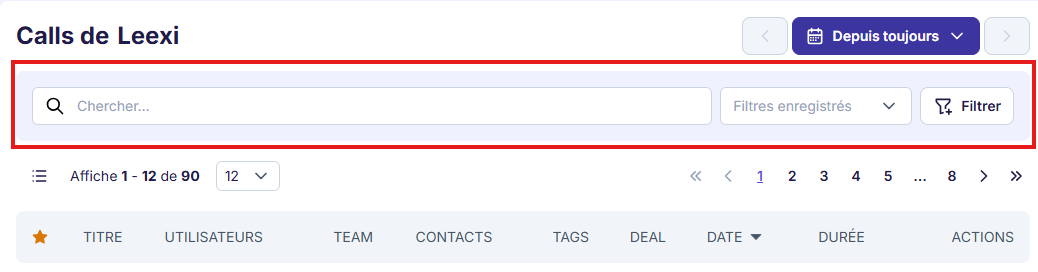
By default, each user only sees their own calls. They can browse the search bars to view other people's calls, within the limits of the access rules set for the company.
Identify the visibility need
List the teams, users or use cases that need to access calls outside their standard scope.
Open the page
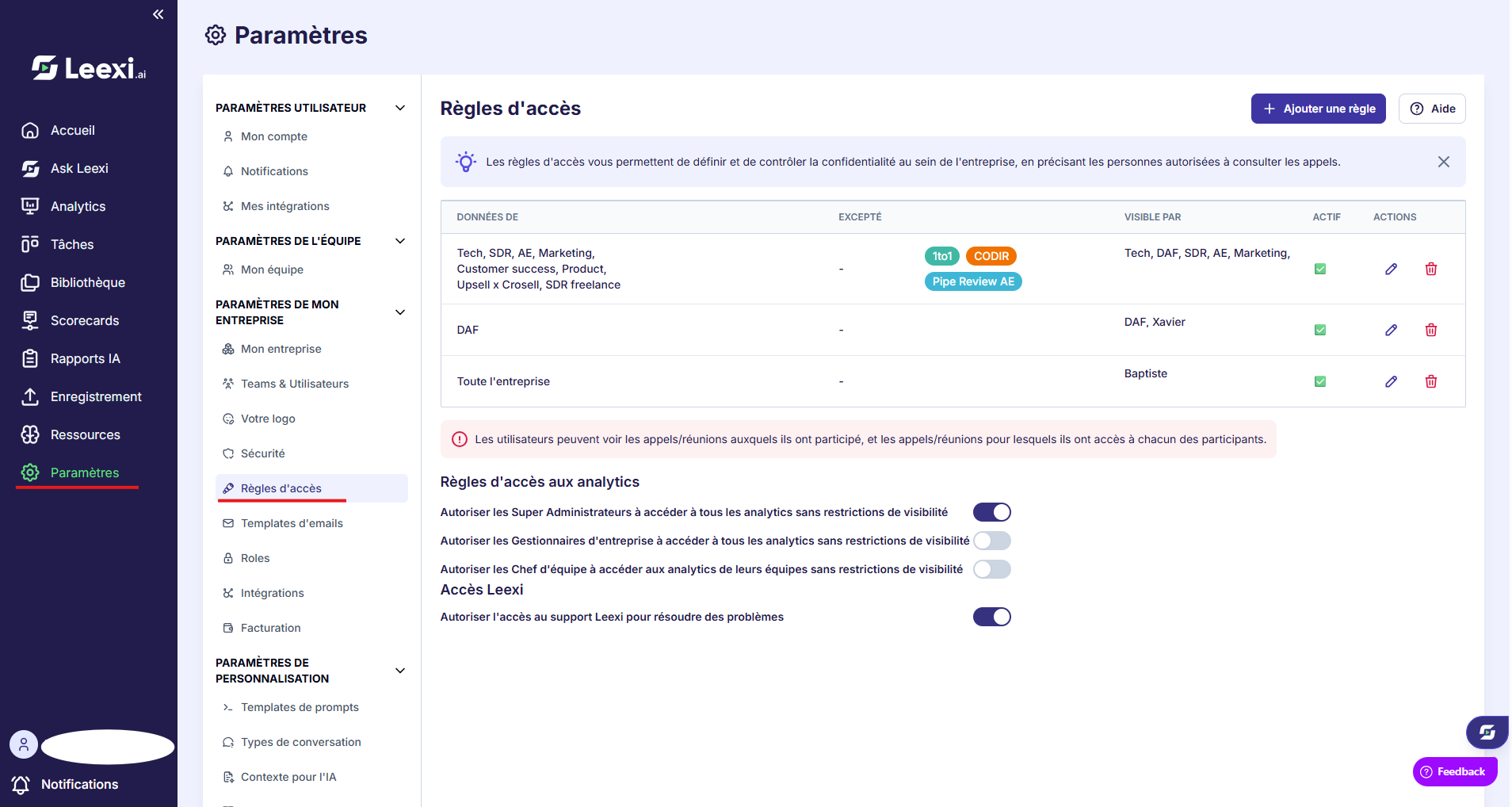
Go to Settings > Governance > Access rules. The page starts with two accordions, Analytics Access rules and Leexi Access, then lists the rules by type: users, API keys and webhooks. The API key and webhook sections only appear if your company has at least one.
Rule types and fields: see References › Roles and security › Access rule types.
Create a rule
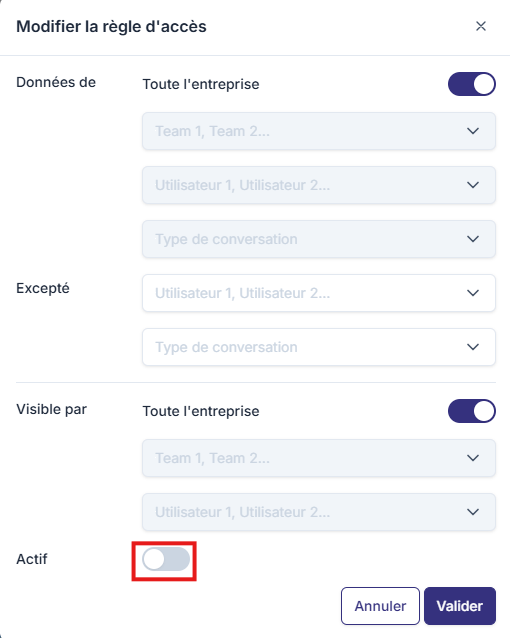
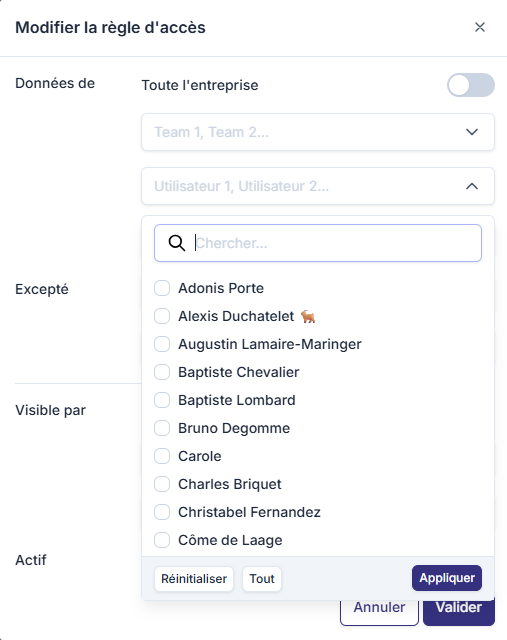
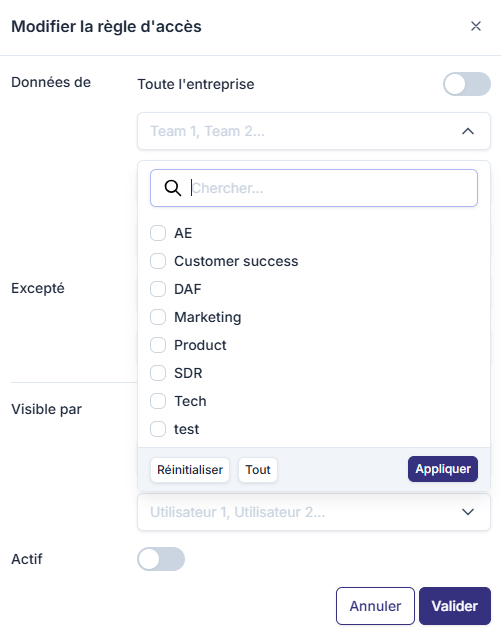
In the section of the relevant type, click Add. Fill in Data of (whose calls are opened), Except if needed (users or conversation types to remove from the scope), then Visible by (who receives access), and save.

Manage an existing rule
To delete a rule, click the trash icon. To temporarily disable it, click it, then disable the Active switch.
Add access on a specific call
On a specific call, click the Sharing & Access button. A button lets you enable or disable custom access for this call. You can then add or remove members from the list manually.
Check the result
Check the behavior on the calls concerned to confirm that the rule does add the expected visibility.
Adjust over time
Review the exceptions and the groups concerned as your organization changes.
Going further
- Access rules complement roles, they don't replace them.
- They are useful for cross-functional managers, operations, or supervision needs.
- Well structured, they avoid oversizing admin roles.
- An API key or webhook attached to a user inherits that user's access; create an application user for an automation that matches no person.
Frequently asked questions
Settings > Advanced.Things to watch out for
- Too many rules become hard to maintain.
- Systematically check the combined effect of roles and rules.
- Document sensitive exceptions to keep clear governance.